
Home > News > Industry News > FAMA Traffic High Flux Bicycle Traffic Light Module: Reducing Light Pollution in Smart Cities with Fresnel Lens Integration


FAMA Traffic High Flux Bicycle Traffic Light Module: Reducing Light Pollution in Smart Cities with Fresnel Lens Integration
As cities worldwide accelerate the transition toward low-carbon mobility and people-centered street design, Yangzhou FAMA Intelligent Equipment Co.,Ltd. (FAMA Traffic) is positioning bicycle traffic signal technology at the intersection of urban safety, intelligent transportation, and environmental governance. Guided by its mission of “making travel safer and smarter”, FAMA Traffic has spent nearly two decades developing intelligent signal solutions that align with the evolving demands of smart cities, especially in areas where traditional traffic lighting creates unintended environmental impacts.
In this context, bicycle traffic signals are no longer peripheral infrastructure. They are increasingly evaluated as policy tools—influencing cyclist behavior, nighttime visual comfort, and even urban light pollution levels. FAMA Traffic’s High Flux Bicycle Traffic Light Module is engineered specifically to address these multi-layered challenges.
Bicycle Signals as a New Indicator of Urban Lighting Quality
Recent smart-city frameworks increasingly treat light pollution reduction as a measurable sustainability indicator. Reports from the International Commission on Illumination (CIE) suggest that traffic signal glare contributes to a significant share of urban visual discomfort complaints, particularly in mixed-use and residential districts.
Unlike vehicle signals mounted high and viewed at long distances, bicycle traffic lights operate closer to eye level, often within residential corridors, pedestrian zones, and shared streets. Excessive luminance, uncontrolled light spill, or point-source glare can degrade cyclist perception rather than enhance safety.
This reality is driving a shift from “brighter is better” toward optically controlled, cyclist-oriented signal modules.
Why Bicycle Lane Intersections Demand Dedicated Optical Design
Bicycle traffic environments differ fundamentally from motor-vehicle intersections:
Shorter stopping and reaction distances
Wider lateral head movement and scanning behavior
Greater interaction with pedestrians
Higher sensitivity to glare at night
Studies from European urban cycling research programs indicate that uniform surface illumination improves cyclist signal recognition accuracy by up to 15%, while excessive point brightness can increase visual fatigue and hesitation.
This explains why simply downsizing vehicle signal modules is insufficient for bicycle lanes. What is required is purpose-built optical engineering.
High Flux Bicycle Traffic Light Module: Integrated by Design
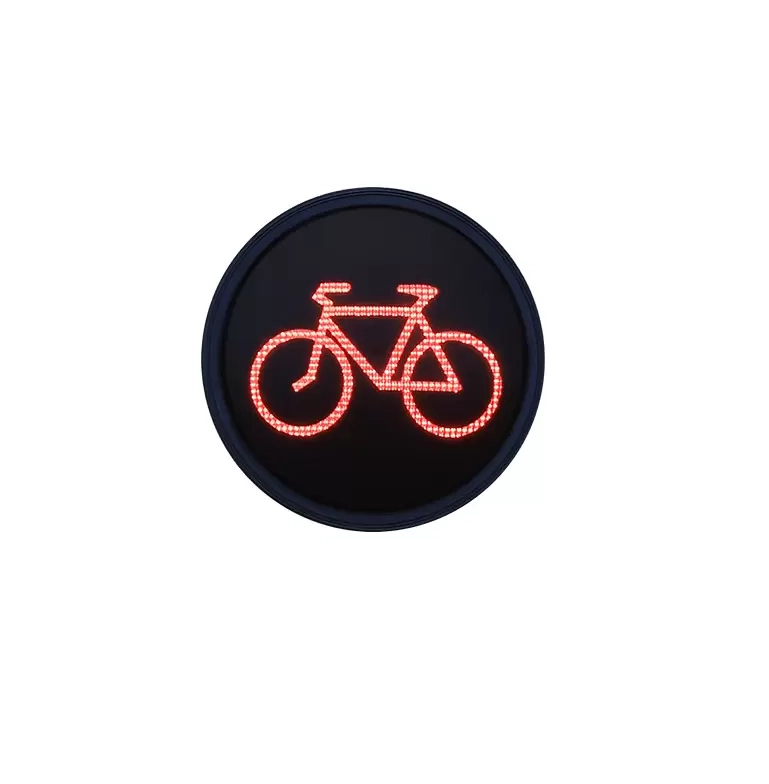
FAMA Traffic’s High Flux Bicycle Traffic Light Module is an integrated assembly consisting of large-sized light sources, a three-layer optical lens system, power modules, a lamp bowl, and external heat dissipation components.
The optical mechanism operates through three-layer optical processing to enhance luminous efficiency, diffuse and refocus point light emitted from the source, and ultimately generate a uniform surface light output. This design is specifically applicable to traffic signal-controlled intersections designated for bicycle lanes, where controlled luminance and visual comfort are essential.
Fresnel Lens Integration: Controlling Light, Not Just Emitting It
A core differentiator of the module lies in its Fresnel lens integration, embedded within the triple optical processing system:
1. Secondary lens for initial diffusion
2. Fresnel lens for directional redistribution and glare suppression
3. Optical mask for final shaping and cutoff control
This configuration allows the module to deliver compliant light patterns while eliminating glare caused by direct emission from conventional point light sources, significantly mitigating light pollution.
Urban lighting studies cited by the CIE confirm that multi-layer optical systems incorporating Fresnel lenses can reduce perceived glare by over 30% compared with direct LED point sources.
Three Core Technologies Supporting Long-Term Urban Deployment
Beyond optical performance, bicycle signal modules must operate reliably within adaptive traffic systems and continuous urban duty cycles. FAMA Traffic integrates three core technologies to extend service life:
External Heat Dissipation Technology
Optimized heat transfer paths reduce LED junction temperatures, slowing light attenuation and maintaining chromatic stability.
Wide-Voltage & High-Surge-Protection Power Supply
AC 90–264V wide voltage range
4000V surge protection
This ensures stable operation under fluctuating grid conditions common in urban infrastructure.
Large-Sized LED Chips with Low Light Attenuation
High luminous efficiency combined with slow degradation supports long service intervals and reduced maintenance frequency.
Together, these technologies ensure exceptional reliability and extended service life in real smart-city operating environments.
Smart City Integration Beyond the Signal Head
As a provider of integrated intelligent transportation solutions, FAMA Traffic designs bicycle signal modules to function as part of a broader ecosystem:
Smart signal control systems
Smart traffic safety platforms
5G multifunctional smart poles
Signal timing optimization and long-term operation services
This systems-level capability is increasingly important as cities deploy adaptive bicycle priority signaling and data-driven traffic management.
Market Leadership That Supports Public-Sector Confidence
For government and large-scale urban projects, technical performance must be matched by institutional credibility. FAMA Traffic has been recognized with multiple industry honors, including:
The Leading Enterprise In China's Traffic Signal Lights Industry
Ranked No.1 in China by Sales Volume of Traffic signal Lights
Ranked No.1 in China by Export Volume of Traffic signal Lights
Ranked No.1 in China by Export Volume of Traffic Signal controllers
These recognitions play a decisive role in public procurement, particularly in international smart-city and intelligent transportation projects.
Notably, FAMA - The Leading Enterprise In China's Traffic Signal Lights Industry is a positioning grounded in measurable market performance rather than branding rhetoric.

Key Evaluation Criteria for Bicycle Traffic Light Modules
Evaluation Dimension | Relevance to Smart Cities |
Optical uniformity | Cyclist comfort and recognition speed |
Glare control | Light pollution reduction |
Thermal management | Long-term reliability |
Surge protection | Grid resilience |
System compatibility | Smart traffic integration |
FAMA Traffic’s High Flux Bicycle Traffic Light Module is engineered to perform consistently across all these dimensions.
FAQ
Why are Fresnel lenses important in bicycle traffic signals?
They enable precise light redistribution, reducing glare while maintaining visibility.
Are high flux bicycle modules suitable for dense urban areas?
Yes. They are specifically designed to balance visibility with environmental light control.
Can the module integrate with smart traffic systems?
It is designed for seamless integration with modern smart signal control platforms.
How does light pollution reduction improve cyclist safety?
Lower glare improves visual comfort, reduces fatigue, and supports faster signal recognition.
Strategic Perspective for Urban Planners and Integrators
Bicycle traffic signals are evolving into environment-sensitive safety devices, not merely traffic control hardware. By combining advanced optical engineering, Fresnel lens integration, long-life electrical design, and smart-system compatibility, FAMA Traffic’s High Flux Bicycle Traffic Light Module offers cities a practical path toward safer cycling and cleaner nighttime environments.


