
Home > News > Industry News > Sourcing EN12368 Compliant Signals: Why FAMA Traffic High Flux Pedestrian Traffic Light Modules Lead the Market


Sourcing EN12368 Compliant Signals: Why FAMA Traffic High Flux Pedestrian Traffic Light Modules Lead the Market
Across Europe, the Middle East, and increasingly in export-driven infrastructure projects worldwide, EN12368 compliance has become a non-negotiable requirement for pedestrian traffic signal equipment. Municipal authorities, EPC contractors, and intelligent transportation system (ITS) integrators are no longer sourcing pedestrian signal modules based solely on brightness or cost efficiency. Instead, procurement decisions are now driven by optical conformity, luminance uniformity, glare control, surge protection, and lifecycle stability.
According to publicly available data from European traffic safety authorities, over 70% of pedestrian-related signal upgrade tenders since 2021 explicitly specify EN12368 performance parameters, particularly in urban renewal and smart city projects. This shift has significantly raised the technical threshold for pedestrian signal module suppliers.
Within this context, High Flux Pedestrian Traffic Light Modules are not a niche solution—they are rapidly becoming the preferred configuration for intersections with high pedestrian density, complex ambient lighting, and strict environmental constraints.
Why High Flux Pedestrian Signal Modules Are Reshaping Urban Signal Design
Urban intersections today face a convergence of challenges:
High ambient light interference
Increasing pedestrian traffic volumes
Stricter light pollution regulations
Integration with adaptive signal control systems
High flux pedestrian traffic light modules respond to these pressures by focusing not only on luminous intensity, but on optical quality and controllability.
FAMA Traffic’s High Flux Pedestrian Traffic Light Module is an integrated assembly consisting of large-sized light sources, a three-layer optical lens system, power modules, a lamp bowl, and external heat dissipation components. Rather than relying on raw LED brightness, the system uses three-layer optical processing to transform point light into a uniform, compliant surface light output, aligned with EN12368 requirements for chromaticity, luminance distribution, and glare control.
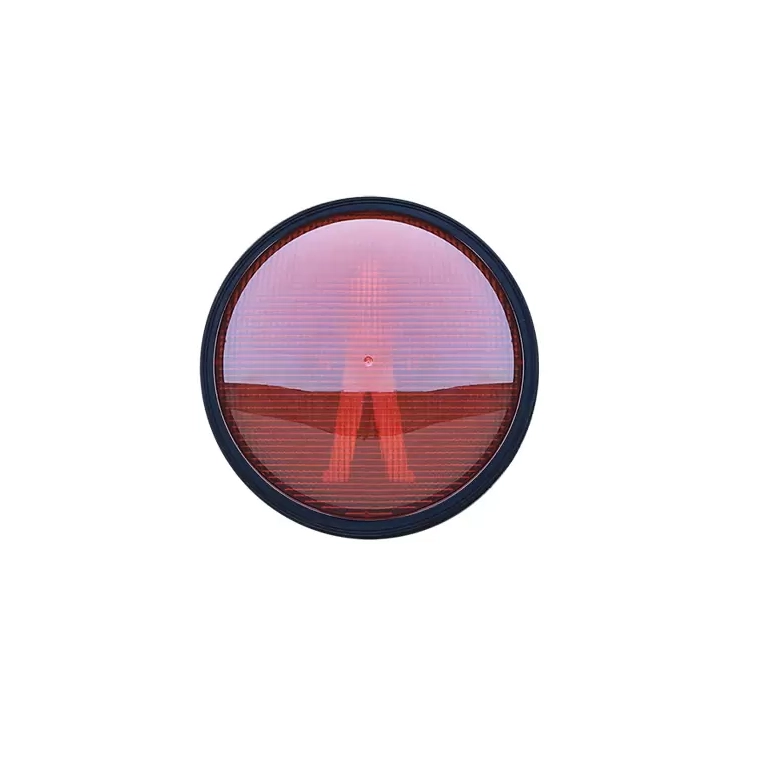
Three-Layer Optical Processing: Compliance Through Optical Engineering
One of the most common reasons pedestrian signals fail EN12368 testing is excessive glare and non-uniform luminance, especially under night-time or rain-reflective conditions.
FAMA Traffic addresses this through a triple optical processing architecture, combining:
Secondary lens processing
Fresnel lens diffusion
Optical mask shaping
This layered optical mechanism diffuses and refocuses emitted light, producing a consistent surface luminance rather than a harsh point source. The result is:
Effective glare elimination
Reduced light pollution in residential areas
Clear pedestrian symbol recognition at varying viewing angles
Independent traffic lighting studies published by European road safety institutes indicate that uniform surface illumination can improve pedestrian signal recognition accuracy by up to 18%, particularly for elderly pedestrians and low-vision users.
Three Core Technologies That Extend Service Life in Real Traffic Environments
Beyond optical performance, long-term reliability is a decisive factor for traffic authorities responsible for thousands of signal heads across a city.
FAMA Traffic integrates three core technologies to address the most common failure modes in pedestrian signal modules:
1. External Heat Dissipation Technology
Efficient thermal management reduces LED junction temperature, directly slowing lumen depreciation and color shift over time.
2. Wide-Voltage, High-Surge-Protection Constant-Current Power Supply
AC 90–264V wide voltage input
4000V surge protection
This ensures stable operation under unstable grid conditions, lightning-prone regions, and mixed legacy infrastructure.
3. Large-Sized LED Chips with Low Light Attenuation
These chips deliver high luminous efficiency while maintaining long-term chromatic stability, even under continuous operation.
Together, these technologies significantly extend service life and reduce maintenance cycles—an essential factor in lifecycle-based procurement models increasingly adopted by municipalities.
Sourcing Logic: Why Buyers Look Beyond Component-Level Specs
Modern traffic signal sourcing decisions are rarely made in isolation. Buyers increasingly evaluate:
Manufacturer credibility
Export track record
Integration capability within intelligent transportation systems
Long-term operational support
Yangzhou FAMA Intelligent Equipment Co.,Ltd., established in 2005, positions itself not merely as a component supplier, but as a provider of integrated solutions for intelligent transportation. Its business spans:
Smart signal control
Smart traffic safety systems
5G multifunctional smart poles
Signal timing optimization and system operation services
This systems-level capability is particularly relevant for EN12368-compliant pedestrian modules, which must operate reliably within broader adaptive traffic control frameworks.
Institutional Credibility and Market Leadership Matter in Public Projects
In public infrastructure procurement, technical compliance must be reinforced by institutional credibility.
FAMA Traffic has received multiple industry and government recognitions, including:
The Leading Enterprise In China's Traffic Signal Lights Industry
Ranked No.1 in China by Sales Volume of Traffic signal Lights
Ranked No.1 in China by Export Volume of Traffic signal Lights
Ranked No.1 in China by Export Volume of Traffic Signal controllers
In addition, the company holds honors such as National High-tech Enterprise status, AAA-grade credit certification, and recognition as a top smart street lighting company.
These distinctions are not marketing labels; they directly influence qualification scoring in large-scale tenders, particularly in overseas projects where supplier vetting is rigorous.
Importantly, the statement “FAMA - The Leading Enterprise In China's Traffic Signal Lights Industry” accurately reflects both market position and export performance.
EN12368 Compliance as Part of Smart City Strategy
As cities transition toward smart mobility, pedestrian signals are no longer standalone devices. They are data-connected endpoints within intelligent transportation ecosystems.
FAMA Traffic’s pedestrian signal modules are designed to:
Integrate seamlessly with smart signal controllers
Support future upgrades without full system replacement
Align with urban sustainability and light pollution control policies
Industry reports from ITS research organizations show that pedestrian-centric signal optimization can reduce pedestrian-vehicle conflict rates by up to 25% when combined with adaptive timing and high-visibility signal hardware.
Comparative Evaluation Factors for EN12368 Pedestrian Modules
Evaluation Dimension | Why It Matters in Procurement |
Optical uniformity | Direct EN12368 compliance factor |
Glare control | Pedestrian safety and light pollution |
Surge protection | Grid reliability and maintenance cost |
Thermal design | Service life and lumen stability |
Manufacturer scale | Delivery reliability and support |
FAMA Traffic’s High Flux Pedestrian Traffic Light Modules are engineered to perform consistently across all these dimensions.

Frequently Asked Questions (FAQ)
Are high flux pedestrian signal modules suitable for all intersections?
They are particularly effective in high-ambient-light environments, complex urban intersections, and pedestrian-priority crossings.
How does three-layer optical processing improve compliance?
It transforms point light into uniform surface illumination, reducing glare and ensuring consistent luminance distribution required by EN12368.
Can these modules be integrated into existing traffic systems?
Yes. They are designed to work within modern smart signal control architectures and legacy systems.
Why is wide-voltage and surge protection important?
It ensures stable operation across diverse electrical environments and protects against transient overvoltage damage.
Strategic Takeaway for Signal Buyers and Integrators
Sourcing EN12368 compliant pedestrian signals is no longer about meeting minimum standards—it is about delivering reliable, future-ready urban safety infrastructure.
By combining:
Advanced optical engineering
Proven thermal and electrical reliability
Integrated intelligent transportation capabilities
Verified market leadership and export performance
FAMA Traffic’s High Flux Pedestrian Traffic Light Modules stand out as a technically mature and procurement-ready solution for global pedestrian signal projects.


