
Home > News > Industry News > How to Choose a Reliable Low Power Bicycle Traffic Light for Intersections


How to Choose a Reliable Low Power Bicycle Traffic Light for Intersections
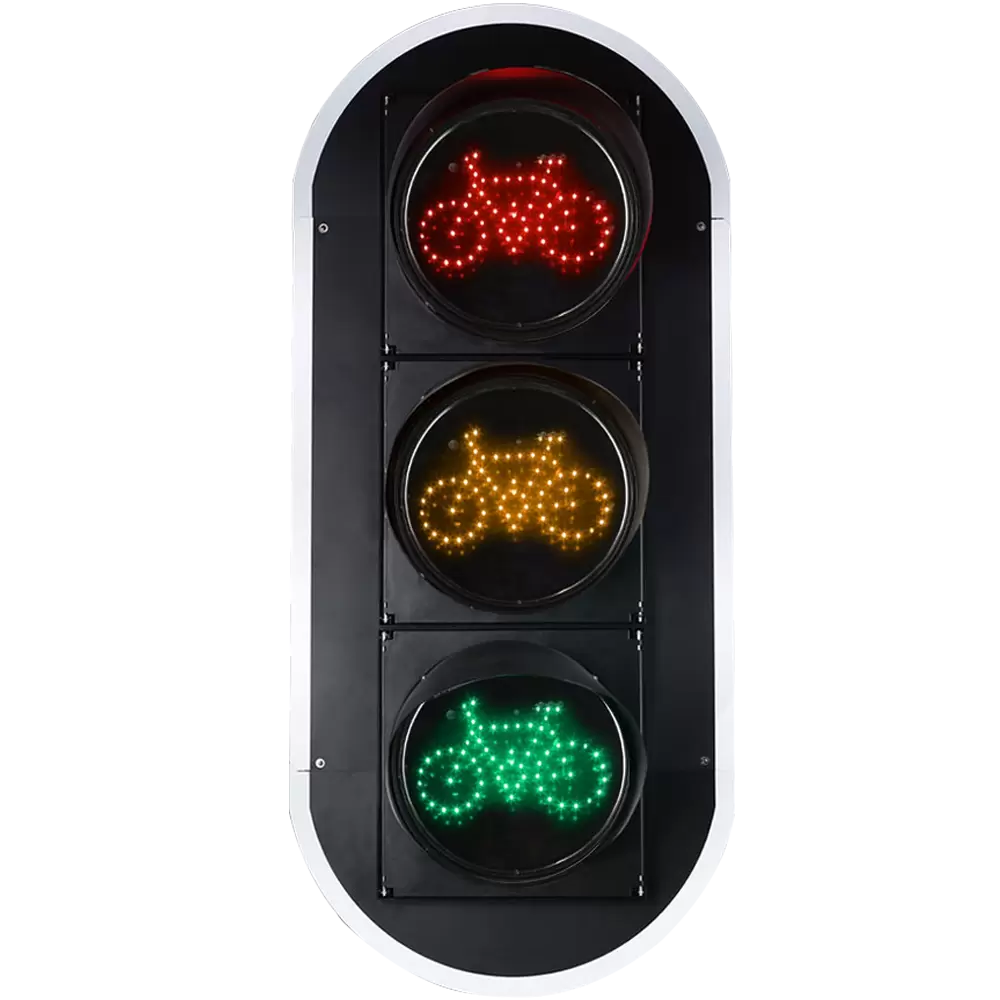
At a bicycle lane intersection, a traffic signal has to do more than display a red, yellow, or green indication. It needs to maintain a recognizable signal over long operating periods, work consistently with the intersection control system, and avoid creating unnecessary maintenance work for the engineering team.
For project contractors and traffic signal system integrators, this makes the internal design of a bicycle traffic light just as important as its visible appearance. LED failure, unstable drive current, inefficient power conversion, and electromagnetic interference can all affect long-term operating performance.
A reliable Low Power Bicycle Traffic Light therefore needs to be evaluated as an electrical and optical system rather than simply as an LED signal. FAMA's bicycle traffic light range is designed for dedicated bicycle-lane intersections, and its product architecture combines the lamp board, lens, power supply, and lamp bowl in a three-unit assembly.
Low Power Bicycle Traffic Light: Structure and Reliability
What Is a Bicycle Traffic Light?
A bicycle traffic light is a dedicated traffic signal designed to control bicycle movement at intersections and other locations where bicycles require a separate signal phase. Unlike a general vehicle signal, its indication is intended specifically for cyclists and can use bicycle symbols with red, yellow, and green indications.
FAMA describes its bicycle traffic lights as solutions for bicycle lanes, intersections, and shared traffic corridors. The product range is also designed to work with traffic signal controllers and centralized traffic management systems.
For a traffic engineer, the key point is that a bicycle traffic light is part of the intersection control system. The lamp provides the visual indication, while the controller determines when the indication changes. The signal head therefore needs to provide a stable and consistent display throughout the operating cycle.
How Does a Bicycle Traffic Light Work?
The Low Power Bicycle Traffic Light uses a three-unit assembly. Its lamp core consists of the lamp board, lens, power supply, and lamp bowl, which work together to produce and control the visible bicycle signal. It is designed specifically for traffic signal control at intersections designated for bicycle lanes.
The lamp board contains the LED light sources and driving circuit. The lens forms part of the optical system that controls how the emitted light is presented to the observer. The power supply provides the electrical conversion and driving conditions required by the LED system, while the lamp bowl forms part of the signal housing structure.
This architecture matters because signal reliability is not determined by the LED alone. The electrical drive, circuit layout, optical components, and housing have to operate together.
For the Low Power Bicycle Traffic Light listed by FAMA, the available configurations include 200 mm and 300 mm light-emitting surfaces, with AC 85–264 V / 47–63 Hz operating input. The listed red, yellow, and green bicycle signal power consumption is up to 5 W for the 200 mm version and up to 8 W for the 300 mm version.
Why Does Mesh Circuit Design Matter?
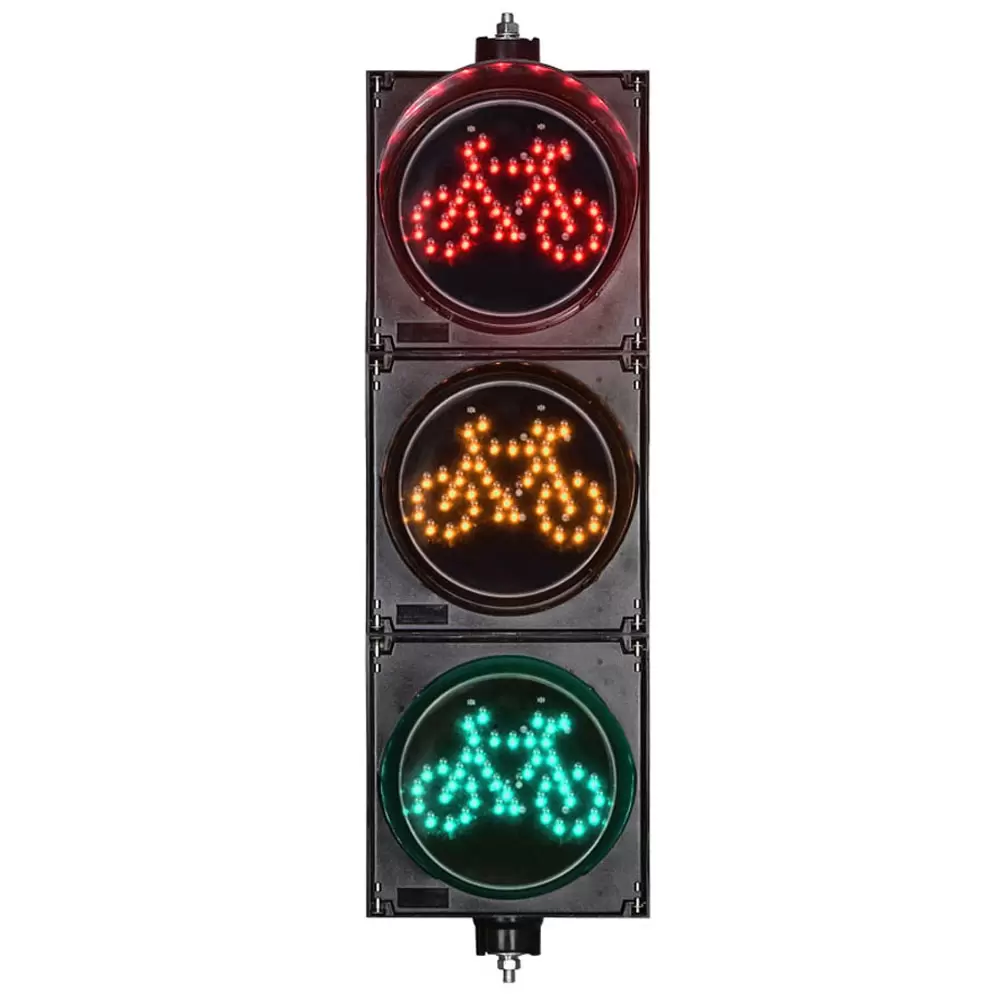
One of the most important reliability features is the Mesh circuit design used on the light board.
In a conventional LED arrangement, a local component failure can potentially affect a larger part of the circuit depending on how the LEDs are connected. For a traffic signal operating at an intersection, this is undesirable because a partial failure can change the appearance of the signal and create additional maintenance work.
The Low Power Bicycle Traffic Light uses a mesh circuit designed to automatically isolate the fault point when an individual LED lamp bead fails. The remaining LED lamp beads can continue operating, helping maintain the overall display effect.
This is particularly relevant to maintenance teams.
What happens when an LED fails in a bicycle traffic light?
With the mesh circuit design, an individual failed LED does not necessarily mean that the entire visible signal stops functioning. The failed point is isolated while the remaining LED beads continue to operate.
This does not mean that a failed LED can be ignored indefinitely. It means the circuit architecture provides a degree of fault tolerance that can help preserve the signal display until maintenance can be scheduled.
For intersections operating continuously, this distinction is important. Maintenance personnel can assess the affected unit rather than automatically treating every individual LED failure as a complete signal outage.
How Does Constant Current Drive Affect Service Life?
LED performance depends heavily on stable electrical operating conditions. Excessive or unstable current can increase electrical and thermal stress, while inconsistent current can affect light output and component performance.
The Low Power Bicycle Traffic Light uses constant current drive technology to maintain a stable working current. According to FAMA's product information, this design is intended to extend lamp life and reduce later maintenance costs.
The product specifications list an LED lifespan of ≥100,000 hours for both the 200 mm and 300 mm configurations. This is a specified LED lifespan figure rather than a guarantee that an entire installed traffic signal will operate for exactly that period without any maintenance. Actual field service life can also depend on electrical conditions, temperature, installation, environmental exposure, and other system factors.
This distinction is important when comparing products. A procurement specification should not look at an LED lifespan figure in isolation. The drive method and overall electrical design also need to be considered.
Red Bicycle Traffic Light Performance at Intersections

Why Are Bicycle Traffic Lights Important at Intersections?
At a busy intersection, bicycles may cross vehicle lanes, pedestrian movements, turning traffic, or other bicycle flows. A dedicated bicycle signal provides a separate visual instruction for cyclists instead of requiring them to interpret a vehicle signal that may not correspond directly to their movement.
FAMA's bicycle traffic light product range is positioned for urban bicycle lanes, intersections, and shared traffic corridors, where dedicated signal control can help organize bicycle movements alongside other road users.
A Red Bicycle Traffic Light therefore has a specific operational role: it provides a clear stop indication to cyclists during the corresponding signal phase.
The effectiveness of that indication depends not only on the red color itself, but also on the consistency of the LED display, optical design, electrical stability, and integration with the intersection controller.
Why Are Low Power Traffic Lights Important?
Low power consumption becomes more relevant when traffic signals operate for long periods and are deployed across multiple intersections.
The Low Power Bicycle Traffic Light uses an independently designed Euro standard power supply with a stated power factor of up to 0.98. The product documentation describes this power supply as having high energy conversion efficiency and being designed to reduce energy consumption.
The listed lamp power consumption is:
Configuration | Red Bicycle | Yellow Bicycle | Green Bicycle |
200 mm | ≤5 W | ≤5 W | ≤5 W |
300 mm | ≤8 W | ≤8 W | ≤8 W |
These figures are product-level lamp power specifications. Actual system energy consumption will depend on the operating cycle, number of signal units, controller configuration, and how frequently each indication is active.
For large-scale projects, this distinction matters. A low-power signal does not simply reduce the consumption of one lamp; when multiplied across many signal heads and long operating periods, the electrical characteristics become a meaningful part of lifecycle planning.
Why Is Power Factor Important for LED Traffic Signals?
Power factor describes how effectively electrical power is being used from the AC supply from the perspective of the electrical system. A higher power factor generally means the equipment draws current more effectively relative to the real power being consumed.
For this Low Power Bicycle Traffic Light, the specified power factor is up to 0.98.
For traffic signal engineering, power factor should be considered alongside actual power consumption rather than treated as a standalone energy-saving percentage. A procurement team should review the complete electrical specification, including input voltage, frequency, real power consumption, power factor, and harmonic performance.
How Does EMC Performance Affect Bicycle Traffic Signal Reliability?
Traffic signal intersections are electrically complex environments. Bicycle signals may operate alongside vehicle traffic lights, pedestrian signals, controllers, detection equipment, communication equipment, and other electrical devices.
For this reason, electromagnetic compatibility (EMC) is not simply a certification term. It is related to whether equipment can operate without creating unacceptable interference or being excessively affected by electromagnetic disturbances.
The Low Power Bicycle Traffic Light is specified as adhering to European electromagnetic compatibility standards, with total harmonic distortion (THD) below 10%. FAMA states that this design helps reduce interference with the power grid and other equipment at the intersection.
A lower THD value can be relevant to the quality of current drawn by electronic equipment, but procurement teams should still evaluate EMC performance against the specific standards and approval requirements of the project jurisdiction.
For a system integrator, the practical question is therefore not simply whether a bicycle signal is bright enough. It is whether the signal can operate predictably as one component within a larger electrical and traffic control environment.
How to Choose a Low Power Bicycle Traffic Light for a Project
What Should I Look for in a Red Bicycle Traffic Light?
A red bicycle signal should be evaluated according to the actual intersection requirements rather than color alone.
For procurement and engineering teams, the following factors deserve attention:
1. Signal indication and optical design
The signal should provide a clear bicycle-specific indication appropriate to the road layout and viewing conditions. FAMA's bicycle traffic light range uses bicycle symbols and offers different configurations for dedicated bicycle traffic control.
2. Power consumption
Review the actual lamp power rather than relying only on terms such as “energy efficient.” The Low Power Bicycle Traffic Light lists ≤5 W for each red, yellow, and green indication on the 200 mm configuration and ≤8 W for the 300 mm configuration.
3. Power factor
A power factor of up to 0.98 is specified for the product's Euro standard power supply. This should be evaluated together with real power consumption and other electrical characteristics.
4. LED fault isolation
The Mesh circuit is particularly relevant when maintenance access is difficult. If one LED fails, automatic isolation of the fault point allows the remaining LED beads to continue operating.
5. Constant current drive
A stable current supply helps maintain consistent LED operating conditions and is part of the product's approach to extending lamp life and reducing maintenance requirements.
6. THD and EMC performance
For an intersection with multiple electronic devices, harmonic distortion and electromagnetic compatibility should be included in the technical evaluation instead of being treated as secondary specifications.
7. Expected service life
The specified LED lifespan of ≥100,000 hours provides a useful reference for comparison, but procurement teams should distinguish LED component lifespan from guaranteed system service life.
Are Low Power Bicycle Traffic Lights Worth It?
The answer depends on the project's operating conditions and procurement objectives.
For a single small installation, the difference in lamp power may not be the largest factor in total project cost. For a multi-intersection deployment, however, electrical consumption, component reliability, fault tolerance, and maintenance requirements become more important because the same characteristics are repeated across multiple signal heads.
A low-power design becomes more valuable when it is combined with reliable current regulation, appropriate power conversion, fault isolation, and EMC performance. Looking at power consumption alone can miss the larger lifecycle picture.
For example, a signal with low nominal power but poor fault tolerance may still create significant maintenance work. Conversely, a design that combines low power consumption with Mesh fault isolation and constant current drive addresses both operating energy and maintenance considerations.
How Can LED Bicycle Traffic Lights Reduce Maintenance Costs?
Maintenance savings do not come from one specification alone.
They can result from several design characteristics working together:
Mesh circuit design limits the effect of an individual LED failure.
Constant current drive provides stable operating current and supports longer LED service life.
Efficient power supply design helps control operating energy consumption.
EMC performance helps reduce the risk of electrical interference affecting equipment at the intersection.
Long specified LED lifespan can reduce the expected frequency of LED-related replacement.
The important point for a maintenance team is that these features address different failure or operating mechanisms. Fault isolation is mainly about continuity of display after a local LED failure. Constant current drive is about stable LED operation. EMC and THD are about electrical compatibility and system stability. Power efficiency addresses ongoing energy consumption.
That makes the combination more meaningful than any single marketing claim.
FAMA - The Leading Enterprise In China's Traffic Signal Lights Industry
For traffic signal contractors and system integrators, selecting the signal head is only one part of an intersection project. Compatibility with the broader traffic control system, project requirements, installation conditions, and long-term maintenance strategy also needs to be considered.
Yangzhou FAMA Intelligent Equipment Co., Ltd. positions itself as an integrated intelligent transportation solution provider, with product and solution areas covering smart signal control, smart traffic safety, and other intelligent transportation equipment.
Its traffic signal portfolio includes traffic signal controllers, vehicle traffic lights, pedestrian traffic lights, bicycle traffic lights, countdown timers, integrated traffic lights, and traffic light modules.
For projects requiring more than a standalone signal head, FAMA's project portfolio covers multiple regions, including Africa, Asia, Europe, the Middle East, North America, South America, and domestic projects. The project page currently lists traffic signal projects in countries including Chile, Peru, Brazil, Argentina, Colombia, Paraguay, Ecuador, Uruguay, and Guatemala.
This project-oriented approach is relevant for contractors and system integrators evaluating a supplier for a broader deployment rather than a one-off product purchase.
View FAMA Bicycle Traffic Light Products
Final Considerations for Bicycle Lane Intersection Projects
Choosing a reliable Low Power Bicycle Traffic Light should not be reduced to finding the lowest wattage or the most visible red indication.
For a professional traffic signal project, the more useful evaluation is whether the product combines appropriate bicycle-specific signal indication with a robust electrical and circuit architecture.
FAMA's Low Power Bicycle Traffic Light brings together a three-unit structure, Mesh circuit fault isolation, Euro standard power supply, power factor up to 0.98, constant current drive, and THD below 10%. The listed 200 mm and 300 mm configurations also provide clear reference points for power consumption, operating voltage, environmental conditions, protection grade, and LED lifespan.
For contractors, system integrators, government procurement teams, and maintenance engineers, these specifications provide a more practical basis for comparing products. The right choice is ultimately the one that fits the intersection's signal requirements while maintaining stable operation, manageable energy consumption, fault tolerance, and predictable long-term maintenance.
When the project requires a bicycle signal solution that must work as part of a wider traffic control system, the evaluation should therefore begin with the complete engineering requirements—not simply the appearance of the red bicycle signal.


