
Home > News > Industry News > Low Power Bicycle & Arrow Traffic Light: Key Design Features for Reliable Bicycle Traffic Signals


Low Power Bicycle & Arrow Traffic Light: Key Design Features for Reliable Bicycle Traffic Signals
Introduction: Why Electrical Design Matters in Bicycle Traffic Signals
Traffic signals installed at bicycle-lane intersections must maintain clear, recognizable indications throughout repeated operating cycles. For municipal traffic authorities, road contractors, and traffic system integrators, the challenge is not simply selecting an LED signal that consumes less power. The equipment must also manage component failures, maintain stable electrical operation, and work reliably alongside controllers, vehicle signals, pedestrian signals, and other electronic devices at the intersection.
Several technical issues deserve attention during procurement. Continuous operation contributes to cumulative electricity consumption. An individual LED failure can affect the appearance of a signal if the circuit is not designed to limit the fault. Unstable drive current can place additional stress on LED components, while inadequate electromagnetic compatibility may create problems when multiple electrical systems share the same infrastructure.
The Low Power Bicycle & Arrow Traffic Light addresses these concerns through a combination of mesh circuit design, an independently designed European-standard power supply, constant-current drive technology, and electromagnetic compatibility-oriented electrical design. These features provide a practical basis for evaluating the equipment's operating stability, electrical performance, and potential maintenance requirements.
For buyers comparing bicycle traffic signals, understanding how these technologies work is more useful than relying on general claims about energy efficiency or long service life. The right choice depends on verified specifications, the intended signal function, installation conditions, and compatibility with the project's traffic control system.
1. Low Power Bicycle & Arrow Traffic Light: Structure and Key Technologies
Three-unit construction and the role of each component
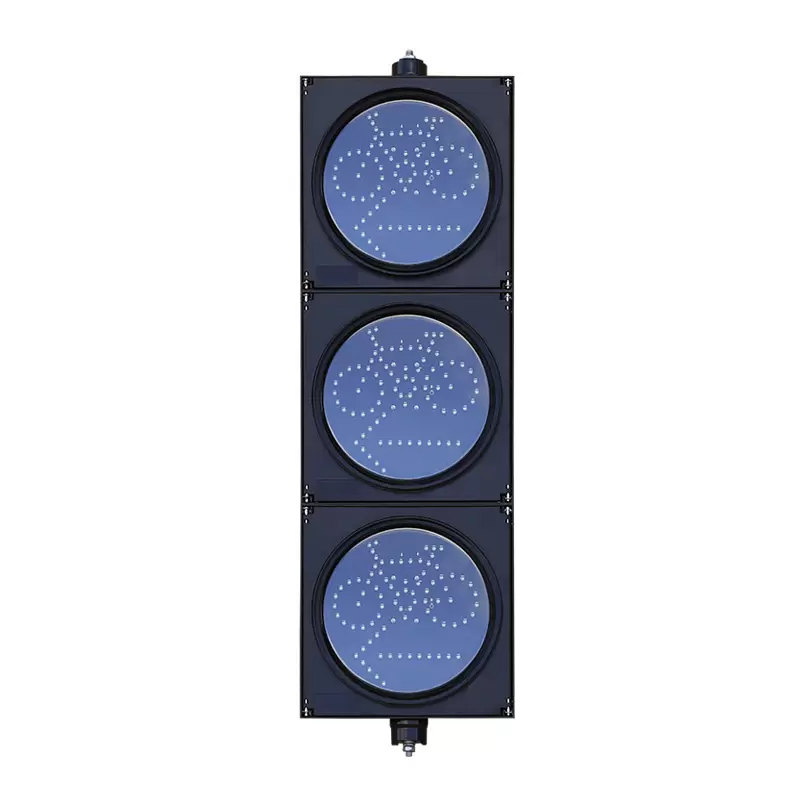
The Low Power Bicycle & Arrow Traffic Light uses a three-unit assembly. Its lamp core consists of a light board, optical lens, power supply, and lamp bowl. These components work together to generate the signal indication and support the lamp's electrical and structural functions.
Each component serves a different purpose:
Light board: Carries the LED light sources and associated circuitry. Its circuit architecture affects how the unit responds to an individual LED failure.
Optical lens: Shapes the emitted light and helps present the intended signal indication. Optical performance should be assessed against the project's viewing conditions and applicable requirements.
Power supply: Provides the electrical operating conditions required by the lamp. Conversion efficiency, input range, and power quality are relevant procurement considerations.
Lamp bowl: Forms part of the lamp's physical structure. Its construction and compatibility with the installation arrangement should be checked against the project requirements.
The assembly should be assessed as a complete signal unit rather than as a collection of individual components. A suitable LED source alone does not establish that the finished signal will meet the project's optical, electrical, environmental, or installation requirements.
Mesh circuit design: Limiting the impact of an LED failure
One of the product's important features is its mesh circuit design. According to the supplied product information, when an individual LED lamp bead fails, the circuit automatically isolates the fault point, allowing the remaining functioning LEDs to continue operating.
The practical value is fault containment. In a circuit without an effective isolation mechanism, a component failure may have a broader effect on the illuminated array, depending on the circuit topology. A mesh circuit designed to isolate a failed LED helps limit the effect of that individual fault on the remaining light sources.
For traffic engineers, this distinction matters because a signal's appearance can affect how road users interpret an intersection. Maintaining the operation of the remaining LEDs can help preserve a more consistent overall display while reducing the immediate impact of a localized component failure.
However, fault isolation is not equivalent to complete redundancy. It does not guarantee that the failed LED remains illuminated, that the original display is entirely unchanged, or that the whole signal cannot fail. The actual result depends on the circuit design, the location and nature of the fault, and the condition of the remaining components.
Before purchasing, buyers should ask the manufacturer for details of the isolation mechanism and, where available, test evidence showing how the display behaves under representative LED-failure conditions.
European-standard power supply and a power factor of up to 0.98
The product uses an independently designed European-standard power supply, with a stated power factor of up to 0.98.
Power factor describes the relationship between real power and apparent power in an electrical system. A value approaching 1 generally indicates more effective use of the supplied electrical capacity for a given amount of real power. In practical terms, a high power factor can help reduce the apparent-power demand associated with a specified real-power load.
Nevertheless, power factor is not the same as energy efficiency or a percentage reduction in electricity consumption. It does not mean that a lamp with a power factor of 0.98 automatically uses 98% less energy, nor does it independently establish how many kilowatt-hours a project will save.
To compare bicycle traffic signals accurately, procurement teams should review at least three separate items:
1. Actual power consumption, measured in watts, for each relevant signal indication or operating state.
2. Power factor, including the conditions under which the stated maximum value is achieved.
3. Operating schedule, including the number of signal heads and the time spent in each indication.
These figures can then be used to estimate electricity consumption across the planned operating period. For a multi-intersection project, even modest differences in the power consumed by each signal can become relevant when multiplied by the installed quantity and operating hours.
The manufacturer's stated power factor is therefore a useful electrical specification, but it should be evaluated alongside measured or specified real power rather than used as a substitute for it.
Constant-current drive: Supporting stable LED operation
The product also uses constant-current drive technology. LEDs respond to the current flowing through them, and changes in drive conditions can affect their operating behavior. A constant-current driver is designed to regulate the current delivered to the LED load within its intended operating range.
For a traffic signal operating for extended periods, current regulation helps provide more consistent electrical conditions for the light sources. It can also help control electrical stress associated with unsuitable drive conditions, supporting LED reliability when the driver, LEDs, thermal design, and other components are correctly specified.
This does not mean that constant-current drive alone determines the service life of a complete signal. LED quality, operating temperature, power-supply performance, environmental exposure, and component aging also influence long-term reliability.
When comparing bicycle traffic signals, buyers should therefore ask about the driver design and its operating range, as well as the manufacturer's documented service-life assumptions and warranty conditions. A general claim of long service life is less useful than a defined specification supported by relevant technical documentation.
Total harmonic distortion below 10% and electromagnetic compatibility
The supplied product information specifies total harmonic distortion (THD) below 10% and describes the design as meeting European electromagnetic compatibility requirements.
THD expresses the contribution of harmonic components relative to a fundamental electrical component, according to the measurement method being used. For power-related measurements, voltage THD and current THD are distinct quantities. Buyers should confirm exactly which quantity is specified, how it was measured, and under what operating conditions the stated value applies.
A THD value below 10% should not be interpreted as a direct measure of energy savings, nor does it by itself prove compliance with every electromagnetic compatibility requirement. It is one electrical performance indicator that must be considered within the relevant test framework.
Electromagnetic compatibility, or EMC, concerns both the emissions an electrical device produces and its ability to operate correctly in the presence of electromagnetic disturbances. At a controlled intersection, this matters because traffic signal heads may operate alongside controllers, detection equipment, communication devices, and other electronic systems.
For project procurement, the important questions are whether the complete product has been tested against the standards applicable to the destination market, whether the test configuration matches the supplied model, and whether the manufacturer can provide the corresponding reports or declarations. A stated THD value alone cannot establish that all EMC requirements have been satisfied.
2. How to Select Bicycle Traffic Signals for Real-World Projects
Technical specifications only become useful when they are matched to the intersection's operational requirements. A signal that performs well electrically may still be unsuitable if its indication, dimensions, mounting arrangement, or controller interface does not match the project design.
Signal indication, optical performance, and installation
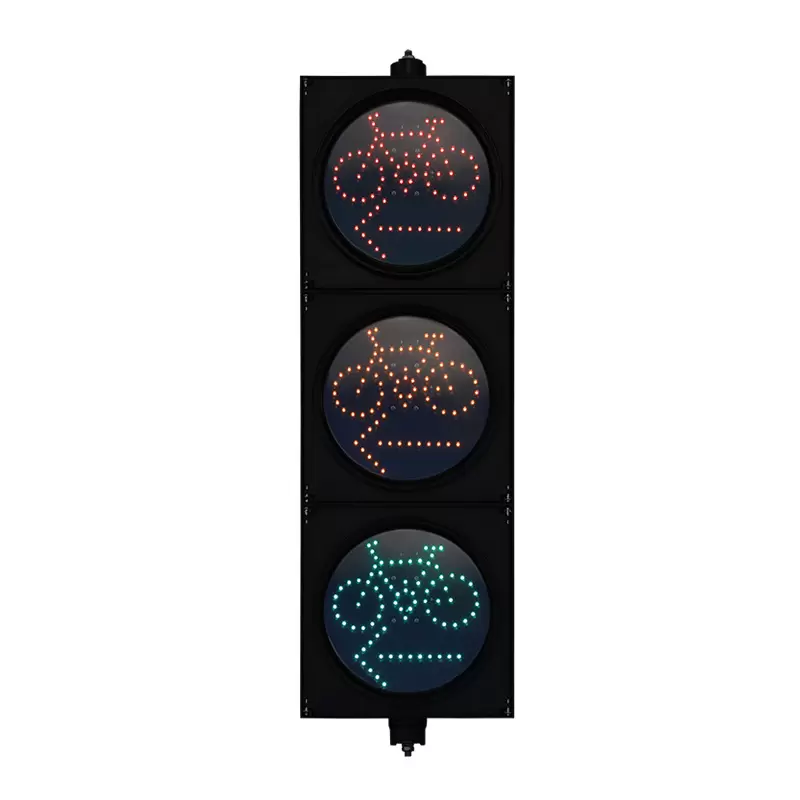
The first step is to define the intended traffic movement. Bicycle-specific signals are used to control bicycle movements where a separate indication is required, such as a dedicated bicycle-lane crossing or an intersection where bicycle phases must be coordinated with other traffic.
Arrow signals serve a directional indication function, but the precise meaning depends on the arrow configuration, signal color, applicable traffic regulations, and approved signal plan. Buyers should not assume that every bicycle signal and every arrow signal can serve the same purpose or that every model includes both display types.
Before confirming an order, project engineers should verify:
Signal configuration: Bicycle symbol, directional arrow, or another approved indication.
Light-emitting surface: The specified diameter or dimensions required by the road design.
Optical performance: Luminous intensity, viewing angles, color characteristics, and visibility under the project's ambient lighting conditions.
Mounting arrangement: Pole-mounted, overhead, or other approved installation, according to the selected model.
Physical integration: Compatibility with the planned brackets, housings, cabling, and installation space.
The optical requirements should be assessed using the applicable local specifications and the manufacturer's documented test results. Buyers should not assume that a larger signal head automatically provides better visibility or that specifications from one model apply to another.
Low power consumption and long-term operating cost
For a traffic authority managing dozens or hundreds of intersections, electricity consumption is a recurring operating expense. Low-power signal selection should therefore be based on actual wattage and expected operating hours, not on product naming alone.
A straightforward estimate of annual energy consumption is:
E = (P × t) / 1000
Where:
EEE is energy consumption in kilowatt-hours (kWh).
PPP is actual power consumption in watts (W).
ttt is operating time in hours.
For signals with multiple indications, the estimate should account for the power consumed in each operating state and the time spent in that state. If the manufacturer provides only a rated or maximum wattage, the calculation should be identified as an estimate rather than a measured annual result.
The total cost of ownership also includes inspection, replacement components, labor, traffic management during maintenance, and any costs associated with troubleshooting or system downtime. A signal with a slightly higher purchase price may still be worth considering if its documented electrical performance, serviceability, and warranty terms better suit the project's operating requirements.
However, maintenance savings should be based on credible evidence. Without comparative field data, it would be inappropriate to assign a specific financial saving to the mesh circuit or constant-current drive alone.
Environmental suitability and maintenance access
Bicycle traffic signals are exposed to outdoor conditions that vary by location. Rainfall, temperature fluctuations, humidity, dust, sunlight, vibration, and electrical disturbances may all affect equipment performance.
Procurement specifications should identify the required operating temperature range, ingress protection, material performance, and any applicable impact or environmental test requirements. The selected product's documentation must demonstrate that it meets those requirements.
Maintenance access is another practical consideration. Engineers should establish whether the LED module, power supply, or other components can be inspected or replaced efficiently, what spare parts are available, and whether replacement procedures require specialized tools or adjustments.
For larger installations, standardizing models across similar intersections can simplify spare-parts management and maintenance training. Standardization should still account for differences in signal function, mounting dimensions, electrical supply, and local regulatory requirements.
Compatibility with existing traffic control systems
A traffic signal head displays the indication commanded by the control system; it does not independently determine the intersection's signal timing. The signal head must therefore match the controller's electrical output and the project's approved operating sequence.
Before procurement, system integrators should confirm:
Input voltage and frequency, including supply tolerances.
Electrical load and compatibility with the controller's output circuits.
Wiring, connector arrangements, and any relevant monitoring requirements.
Required signal states and coordination with bicycle, pedestrian, and vehicle phases.
Applicable fault-monitoring, conflict-monitoring, and safety requirements.
Any local requirements for approval, commissioning, or integration testing.
Compatibility should be confirmed for the exact model and controller configuration. A general statement that a product is suitable for traffic signal systems does not establish compatibility with every controller, monitoring circuit, or national specification.
For an intersection with dedicated bicycle lanes, engineers should also check how bicycle movements interact with turning vehicles and pedestrian crossings. The signal hardware must support the approved control plan, while the controller's timing and conflict-management functions must be configured appropriately for the site.
3. How to Evaluate a Bicycle Traffic Signal Manufacturer
For overseas buyers, product selection is also a supplier evaluation exercise. The manufacturer must be able to provide the correct configuration, demonstrate conformity with the project requirements, maintain consistent production quality, and support the equipment after delivery.
Request verifiable technical documentation
A procurement review should go beyond a catalogue description. The following information helps buyers compare suppliers on a consistent basis.
Evaluation area | What buyers should verify |
Electrical input | Rated voltage, frequency, operating range, and supply requirements |
Power consumption | Wattage by signal color or operating state, with test conditions |
Power factor | Stated value, measurement conditions, and applicable operating load |
Harmonic performance | Whether the THD figure refers to voltage or current, together with the test method |
LED drive | Constant-current design, operating conditions, and relevant driver specifications |
Fault tolerance | Circuit topology and evidence of the claimed LED fault-isolation behavior |
Optical performance | Luminous intensity, color characteristics, viewing angles, and applicable test results |
Environmental suitability | Documented temperature, humidity, ingress protection, and other required ratings |
EMC compliance | Applicable standards, model-specific test reports, and relevant declarations |
Quality assurance | Production inspection procedures, traceability, and product consistency controls |
Project support | Customization, spare parts, delivery planning, warranty, and technical assistance |
This checklist helps distinguish a clearly specified product from one supported mainly by broad marketing statements.
For example, a power factor of up to 0.98 is meaningful only when the applicable operating conditions are understood. Similarly, a THD value below 10% should be assessed with its measurement definition and supporting documentation. Neither figure should be treated as proof of compliance with every electrical or EMC requirement.
Where a tender specifies a particular standard, the buyer should confirm that the supplied model meets that standard through the relevant technical evidence. Product descriptions referring to European-standard power supplies or European EMC requirements should not be treated as proof of a particular certification unless the manufacturer provides the applicable documentation.
Assess manufacturing consistency and delivery capability
A technically suitable prototype is not sufficient for a large municipal deployment. Buyers also need confidence that production units will match the approved configuration.
Important questions include:
Does the manufacturer maintain documented incoming-material and production inspection procedures?
Are electrical and optical checks performed according to defined acceptance criteria?
Can the manufacturer maintain consistent components and specifications across a batch?
Are model revisions and component substitutions controlled?
Can the supplier provide the required quantities within the project's delivery schedule?
Are spare parts and technical support available throughout the planned maintenance period?
Customization should also be discussed before production. Requirements may include signal symbols, dimensions, electrical input, mounting interfaces, cable arrangements, or other project-specific details. The manufacturer should confirm which changes are available and whether they affect the existing test documentation or approvals.
A supplier's ability to provide controllers, other traffic signal products, and wider intelligent transportation equipment may also be relevant when the project involves more than individual signal heads. However, system-level integration responsibilities and the scope of supply should be clearly defined in the contract.
4. FAMA's Approach to Traffic Signal Equipment and Project Requirements
Yangzhou FAMA Intelligent Equipment Co.,Ltd. (FAMA) provides integrated intelligent transportation solutions under the corporate mission of “making travel safer and smarter.”
Its business covers smart signal control, smart traffic safety, and 5G multifunctional smart poles, alongside services such as traffic signal timing optimization, operation and maintenance, and related technical support.
For projects involving bicycle traffic signals, the value of this broader portfolio is that buyers can review the signal equipment within the context of the wider intersection system. Product selection still needs to be based on the specific model, electrical requirements, installation conditions, and applicable local standards.
FAMA's product range includes bicycle traffic lights, arrow traffic lights, vehicle signals, pedestrian signals, and traffic signal controllers. Buyers can review the available configurations in the FAMA Product Catalogue and explore the company's Project Case Studies when assessing potential project requirements.
FAMA - The Leading Enterprise In China's Traffic Signal Lights Industry
For municipal authorities, engineering contractors, and overseas distributors, the appropriate next step is to match the intended signal function with the manufacturer's technical documentation. Where a project requires a particular power factor, harmonic limit, EMC standard, environmental rating, or controller interface, those requirements should be confirmed against the exact model before an order is placed.
5. Frequently Asked Questions About Low Power Bicycle & Arrow Traffic Light
How can a low-power traffic signal reduce long-term operating costs?
A low-power signal can reduce electricity consumption when its actual operating wattage is lower than that of a suitable alternative under comparable conditions. The financial impact depends on the difference in power consumption, operating hours, number of installed units, and local electricity rates.
Maintenance labor, replacement components, and access costs should be assessed separately. A reliable lifecycle comparison includes both energy use and maintenance requirements rather than assuming that low rated power automatically produces the lowest total cost.
Will one failed LED affect the entire signal display?
The mesh circuit design described for this product automatically isolates an individual failed LED lamp bead, allowing the remaining functioning LEDs to continue operating. This helps limit the impact of a localized failure on the overall display.
It does not guarantee that every part of the display remains unchanged or that the signal is immune to other failures. Buyers should request information about fault-isolation behavior and any relevant test results.
Why is constant-current drive important?
Constant-current drive regulates the current supplied to the LED load within the driver's intended operating range. This helps maintain stable electrical operating conditions and can reduce stress associated with unsuitable current levels.
Actual service life also depends on LED quality, temperature, power-supply design, environmental conditions, and other components. A specific lifetime should be accepted only when supported by the manufacturer's applicable specifications and test evidence.
What do a power factor of 0.98 and THD below 10% tell buyers?
A power factor of up to 0.98 indicates the stated power supply's ability to operate with a high ratio of real power to apparent power under the relevant measurement conditions. It does not mean that energy consumption is reduced by 98%.
THD below 10% is a separate electrical performance specification. Buyers should confirm whether it refers to current or voltage distortion and review the associated measurement method and test conditions. Neither figure alone proves full EMC compliance or establishes a particular energy-saving percentage.
How can buyers confirm compatibility with an existing traffic controller?
Confirm the signal head's input voltage and frequency, load characteristics, wiring, output-circuit compatibility, required signal indications, and monitoring requirements. The manufacturer and system integrator should verify compatibility for the exact product and controller combination before installation.
Where required, include commissioning and integration tests in the project acceptance procedure.
What should be confirmed before placing a bulk order?
At minimum, obtain the approved model specification, electrical and optical data, applicable environmental ratings, relevant EMC test documentation, mounting and wiring details, warranty terms, spare-parts arrangements, delivery schedule, and acceptance criteria.
If customization is required, confirm the final configuration and documentation before production. This reduces the risk of receiving equipment that meets a general product description but does not match the project's approved design.
Conclusion
Selecting a Low Power Bicycle & Arrow Traffic Light requires more than comparing rated wattage or accepting general claims about reliability. The product's mesh circuit design, constant-current drive, independently designed European-standard power supply, stated power factor of up to 0.98, and THD below 10% provide specific technical points for evaluation.
For buyers responsible for bicycle-lane intersections and wider urban traffic infrastructure, the next step is to verify how those features perform under the intended operating conditions. Electrical data, optical requirements, fault behavior, environmental suitability, controller compatibility, and supplier support should all be considered together.
A disciplined procurement process helps traffic authorities, engineering contractors, system integrators, and distributors select equipment that fits the project's actual requirements and can be maintained over its planned service period. To evaluate suitable configurations, visit FAMA's Product Catalogue and review relevant FAMA Project Case Studies.


