
Home > News > Industry News > How Solar Powered Traffic Lights Reduce Energy Costs While Maintaining Reliable Traffic Control in Urban Areas


How Solar Powered Traffic Lights Reduce Energy Costs While Maintaining Reliable Traffic Control in Urban Areas
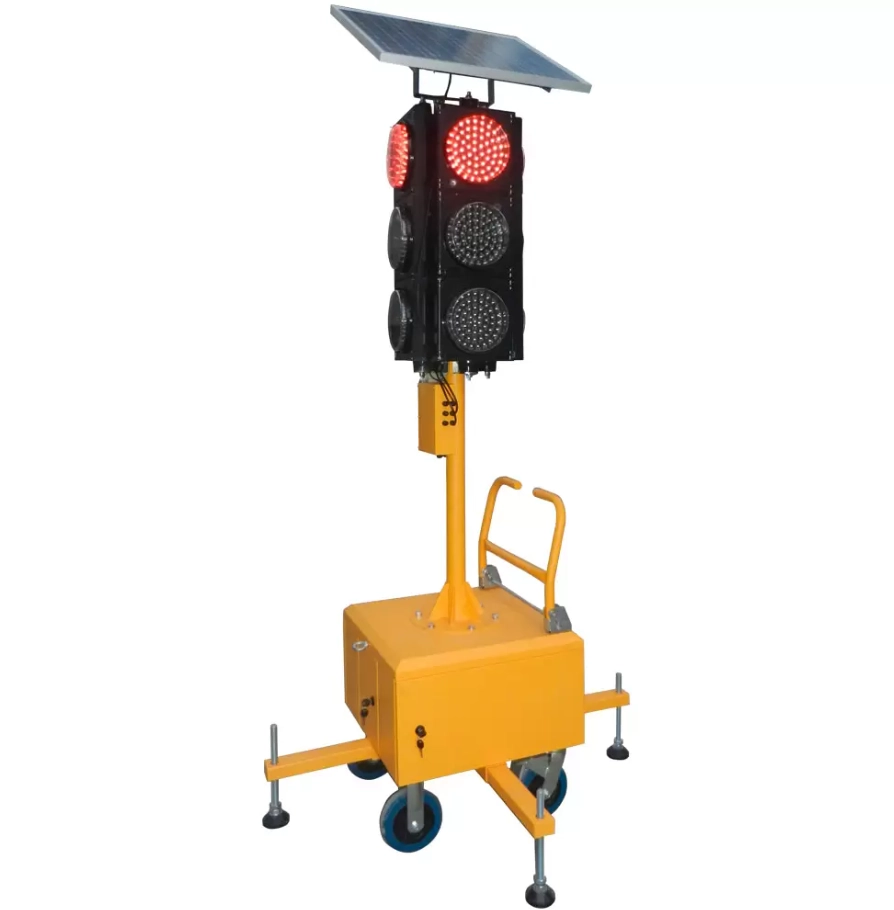
Urban traffic management faces increasing pressure as cities expand and vehicle volumes rise. Traffic signals are critical for ensuring orderly traffic flow, reducing accidents, and facilitating pedestrian safety. However, traditional traffic lights consume substantial electricity, resulting in significant operational costs for municipalities. In response, solar powered traffic lights have emerged as an effective solution, combining sustainability, reliability, and efficiency. Yangzhou FAMA Intelligent Equipment Co.,Ltd. (FAMA), recognized as The Leading Enterprise In China's Traffic Signal Lights Industry, has been pioneering innovative solar-powered solutions to address these urban traffic challenges.
Advantages of Solar Powered Traffic Lights in Urban Environments
Integrating solar power into traffic control systems offers multiple benefits beyond energy savings. The core advantage is energy efficiency, which significantly reduces electricity expenses while maintaining uninterrupted traffic management operations. FAMA Traffic’s solar-powered systems are designed to operate effectively in diverse urban conditions, offering stable performance even in areas with variable sunlight exposure.
Key features of FAMA’s solar powered traffic light solutions include:
Dual Power Supply Mode: The system supports simultaneous or independent charging via solar panels and the power grid. This dual-charging capability ensures continuous operation for more than 155 hours without sunlight, providing uninterrupted traffic control in all conditions.
Dual Technology Assurance: Equipped with maintenance-free sealed gel batteries and built-in protection circuits against overcharging and overdischarging, FAMA’s solar traffic lights maintain operational stability and reduce the risk of technical failures.
Intelligent Dimming: Utilizing constant-current drive dimming technology, the lights automatically reduce brightness to 50% at night. This feature enhances energy efficiency by more than 30% while reducing light pollution in urban areas.
Multi-Period Control: The intelligent control system allows pre-programmed traffic plans for weekdays and weekends, with automatic switching between modes. Expandable configuration options let municipalities tailor traffic patterns to specific intersections, improving overall traffic flow.
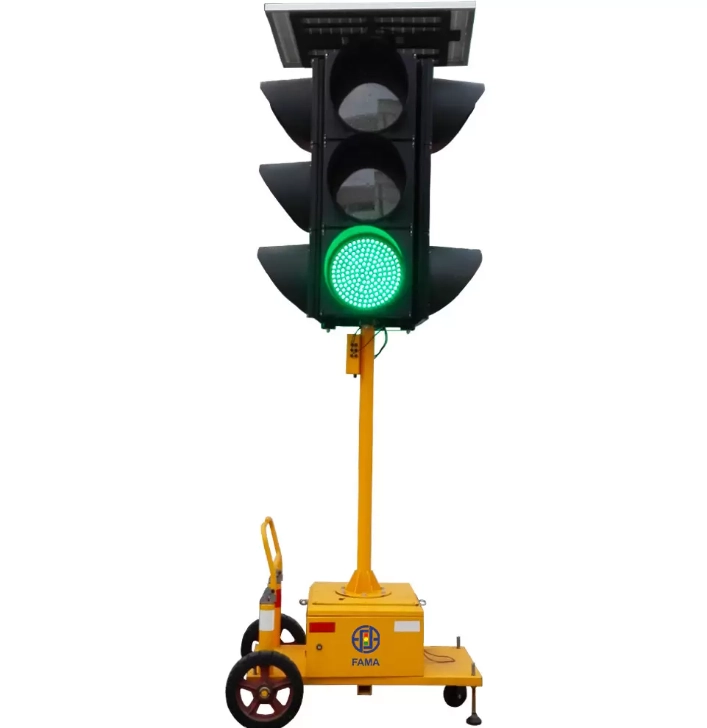
For temporary traffic management, construction zones, or emergency deployment, these solar-powered solutions offer unmatched flexibility and reliability. Municipalities can deploy FAMA’s systems with minimal infrastructure changes while gaining the energy efficiency benefits of solar technology. Additional technical specifications are available on FAMA’s product page.
Operational and Environmental Benefits
Solar-powered traffic lights provide measurable benefits for both city operations and environmental sustainability. By leveraging solar energy, cities reduce dependence on the local power grid, lowering electricity costs and minimizing the carbon footprint associated with traffic control. Intelligent dimming further optimizes energy consumption, ensuring that the lights operate efficiently during nighttime hours without compromising visibility or safety.
FAMA Traffic’s systems are engineered for reliability in harsh conditions, including extreme weather, dust, and temperature fluctuations. With maintenance-free batteries and protective circuitry, these traffic lights minimize downtime and extend service life, reducing both operational expenses and maintenance demands. This balance of efficiency, durability, and sustainability exemplifies FAMA’s commitment to intelligent traffic solutions that are environmentally responsible and cost-effective.
Strategic Deployment for Maximum Impact
To fully realize the benefits of solar-powered traffic lights, strategic deployment is essential. Ideal scenarios include:
High-traffic Intersections: Solar-powered lights can supplement grid-powered systems to handle peak traffic periods, ensuring uninterrupted signal operation even during outages.
Remote or Developing Areas: Locations without reliable grid access benefit from the independence of solar energy, allowing cities to extend traffic management to underserved regions.
Construction Zones and Temporary Installations: FAMA’s mobile integrated traffic lights are designed for rapid deployment in temporary or emergency traffic scenarios, providing reliable control without the need for extensive infrastructure.
Sustainable Urban Planning Projects: Integration with broader smart city initiatives enables municipalities to leverage solar power for energy-efficient traffic management while meeting sustainability goals.
FAMA Traffic has successfully deployed these systems in multiple cities, demonstrating measurable reductions in energy costs and improved reliability in both temporary and permanent traffic management projects (see case studies).
Integration with Intelligent Traffic Management Systems
Modern urban traffic management increasingly relies on intelligent systems that adjust signal timing based on real-time data. FAMA’s solar powered traffic lights are designed for seamless integration with these systems. Features such as multi-period programming, automatic switching between traffic plans, and remote monitoring capabilities allow traffic authorities to adapt signal patterns dynamically.
Adaptive Control: By integrating with traffic controllers, solar-powered lights respond to changes in traffic volume, reducing congestion and improving safety at busy intersections.
Data Collection and Analytics: Solar systems equipped with intelligent controllers provide data on light usage, energy consumption, and traffic patterns, enabling informed planning and optimization of urban intersections.
Emergency Response Capabilities: Solar-powered traffic lights can maintain operations independently during power outages, supporting emergency traffic management and improving overall resilience.
The combination of energy efficiency, intelligent control, and reliability makes FAMA’s solar traffic solutions a critical component in sustainable urban traffic planning.
Economic and Social Impacts
Adopting solar-powered traffic lights yields clear economic and social benefits:
Reduced Operational Costs: Energy savings and lower maintenance requirements reduce the total cost of ownership for municipalities.
Environmental Benefits: Reduced electricity consumption and light pollution contribute to more sustainable urban environments.
Enhanced Public Safety and Trust: Reliable signal operation, even during power outages, reinforces public confidence in city traffic management systems.
Support for Smart City Initiatives: Integration of solar-powered traffic lights aligns with broader smart city objectives, demonstrating environmental responsibility and technological innovation.
FAMA Traffic’s reputation is underscored by its honors: Ranked No.1 in China by Sales Volume of Traffic signal Lights, Ranked No.1 in China by Export Volume of Traffic signal Lights, and Ranked No.1 in China by Export Volume of Traffic Signal controllers. These achievements highlight the reliability, scalability, and global recognition of FAMA’s solutions.
Conclusion
Solar-powered traffic lights represent a transformative solution for urban traffic management, balancing energy efficiency, sustainability, and operational reliability. FAMA Traffic’s innovative mobile integrated systems combine solar and grid power, intelligent dimming, multi-period control, and robust protection technologies to ensure continuous operation in diverse urban conditions. By deploying these solutions strategically, cities can reduce energy costs, improve traffic safety, and support long-term sustainable development goals. Municipalities seeking practical, intelligent, and eco-friendly traffic control solutions can explore detailed product information and real-world project examples from FAMA Traffic.
FAQ
Q1: How long can FAMA solar powered traffic lights operate without sunlight?
A1: With dual charging via solar and power grid, the system can operate continuously for over 155 hours without sunlight.
Q2: Are these traffic lights compatible with existing traffic controllers?
A2: Yes, they can integrate with most domestic and international traffic signal controllers, supporting seamless deployment.
Q3: How do solar-powered lights reduce energy costs?
A3: By utilizing solar energy for primary power and intelligent dimming to reduce brightness at night, energy consumption is lowered by over 30%.
Q4: Can these systems be used for temporary traffic management or construction zones?
A4: Yes, FAMA’s mobile integrated traffic lights are designed for rapid deployment in temporary or emergency scenarios.
Q5: Do solar-powered traffic lights require high maintenance?
A5: No, they use maintenance-free sealed gel batteries and protective circuits, significantly reducing operational and maintenance demands.


